Aqua-ERF Research Infrastructure

State-of-the-art infrastructure
Aqua-ERF has a modern and versatile infrastructure for research on aquaculture and applied aquatic ecology.
The facilities include a recirculating aquaculture system (RAS) with 18 cylindrical tanks, each holding 120 liters, suitable for controlled feeding, growth, and water quality experiments. In addition, there is a RAS with 6 rectangular 1,200 liter tanks for research involving larger animals and the rearing of broodstock, and a RAS with 24 flat rectangular 300 liter tanks for research on crustaceans and other benthic organisms.
For research on seaweed cultivation, there is also a system with 48 containers of 4 liter, equipped with LED lighting with individually controlable wavelengths and intensities.
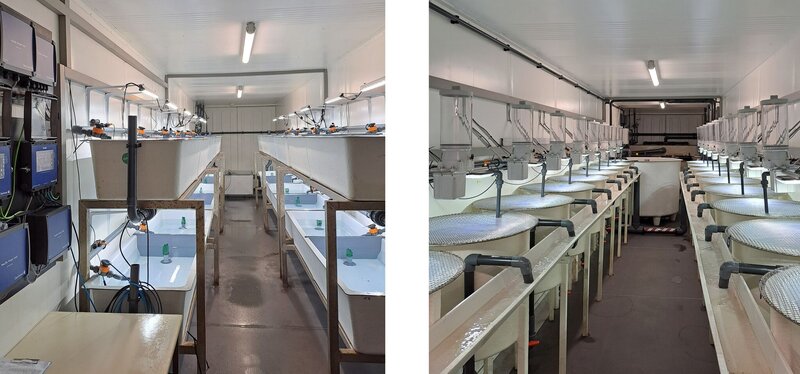
Independent RAS for practice-oriented research on a pilot scale
Thanks to the research infrastructure project of Flanders Innovation & Entrepreneurship (VLAIO), Aqua-ERF now has 12 fully independent 1,800 liter recirculation systems, each with its own filtration and water treatment, and continuous monitoring of the most important water quality parameters. This allows us to reliably test additives, probiotics, feeds, and welfare and stress interventions without cross-contamination between control and experimental groups.
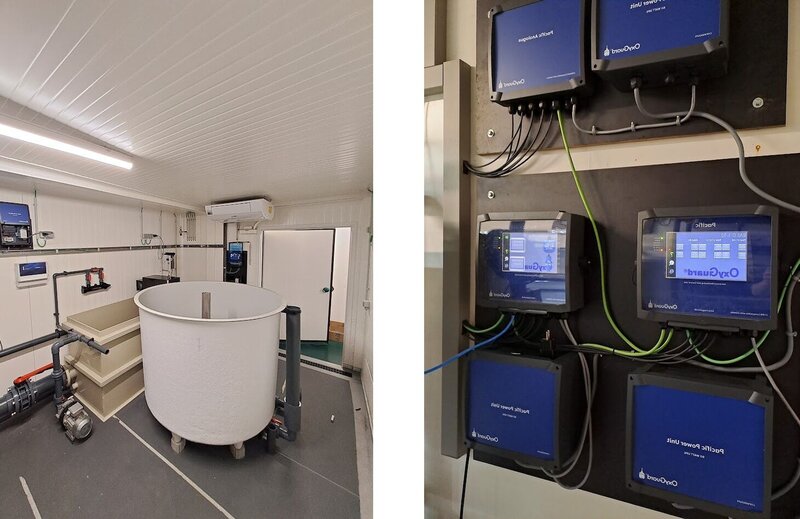
Through an integrated monitoring system from OxyGuard, key water quality parameters — including water level, water flow rate per tank, temperature, oxygen, and pH are monitored 24/7, and researchers are automatically alerted in the event of deviations or emergencies, allowing for rapid intervention.
The industrial-grade quality of the systems enables research with high fish densities and fish raised to market weight. This allows companies to validate innovative applications under realistic commercial conditions.
Controlled feeding and lighting
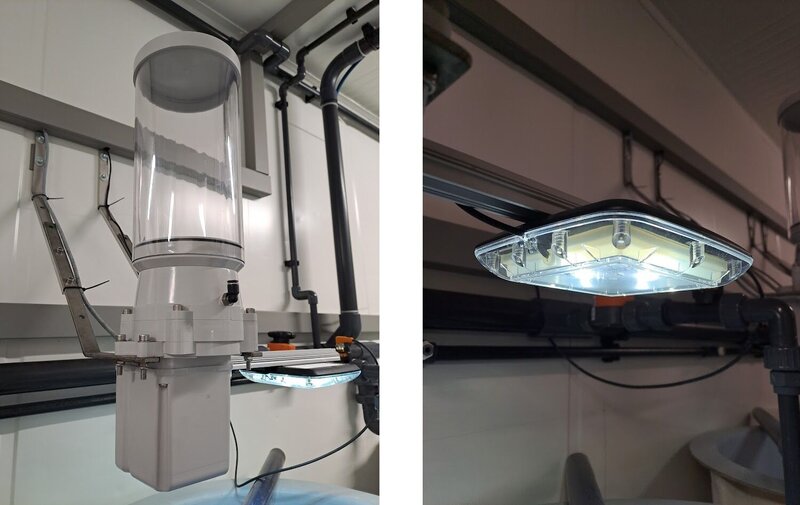
In addition, Aqua-ERF now features an advanced, computer-controlled lighting system from BioLumen that allows for precise manipulation of light regimes, light intensity, and day length. This allows us to study the influence of light on growth, behavior, animal welfare, and stress in aquatic organisms and to optimally tailor these factors to the species and the production process.
At the same time, the system reduces energy consumption for lighting by up to 60% and offers new opportunities to incorporate light as an experimental factor in contract research for companies.
Thanks in part to support from VLAIO, Aqua-ERF now has a fully programmable feeding system from MiraFeed that allows for precise control of both the amount and frequency of feed distribution. This increases the standardization and reproducibility of feeding trials and contributes to the reliability of research results regarding growth and feed conversion.
Moreover, thanks to the large reservoirs and automated operation, daily manual labor is significantly reduced, and feed trials can be conducted more efficiently, also within contract research for companies.
Water Treatment for Crustacean Research
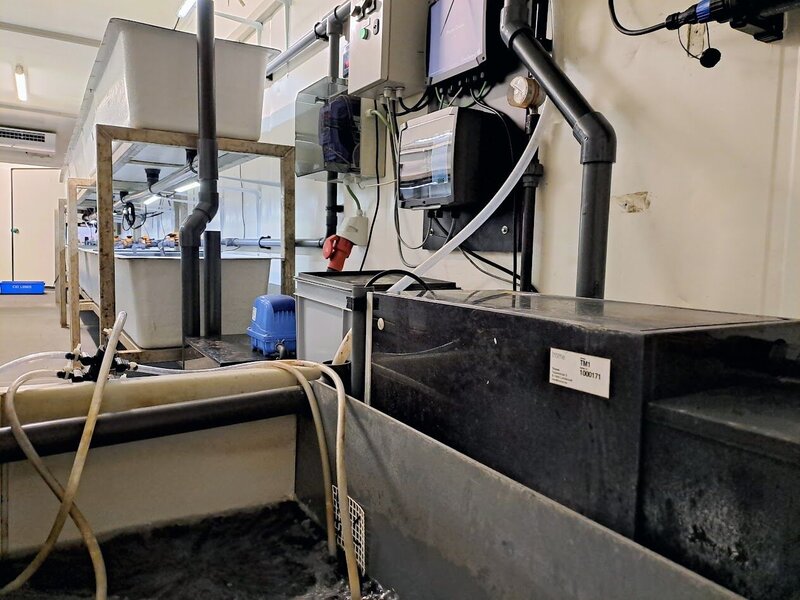
Finally, Aqua-ERF now has a new recirculation system with a Trome drum filter, which efficiently and continuously removes solid particles from the water.
The installation supports research on crayfish for both aquaculture applications and applied aquatic ecology, including the development and evaluation of methods for managing invasive crayfish populations. The improved water purification ensures stable and controllable research conditions, allowing for reliable investigation of both the health and growth of farmed crayfish and ecological interactions and management measures.
With support from