E3-Practicum
Empowering Education in Europe through International Practicum
Together with teacher education institutions and primary schools in Denmark, Austria, Spain and Belgium, we are developing a European framework to better prepare, support and recognize the international teaching practice of student teachers. The project builds on eight years of collaboration in an international consortium, in which the four teacher education institutions kept running into the same challenges: language barriers, different curricula, a hidden curriculum and an unfamiliar school culture. That shared experience is our starting point. Through classroom interventions, a comparison of practicum frameworks and collaboration on eTwinning, we are now working with four partner schools to build a European competence framework, a handbook with guidelines and activities, and models for preparing exchange students. Read on to discover how your school or teacher education institution can get involved or try out materials.
Erasmus+ programme (KA220-HED-2026-002)
Europe in the classroom, the classroom in Europe
From the E3 Semester to E3 Practicum
E3-Practicum builds on a long-standing partnership. From 2017 to 2024, Odisee, Københavns Professionshøjskole, Pädagogische Hochschule Steiermark and the Universitat Autònoma de Barcelona jointly offered the international semester Empowering Education in Europe (E3): a 30-ECTS program for European student teachers, held every spring. Each institution contributed its own theme: Teaching in Europe, Europe in Teaching (Odisee), Communication and Education (PH Steiermark), Education for Citizenship (UAB) and Professional Teamwork (KP). An international placement in a primary or lower secondary school was the common thread running through the semester.
Reforms in teacher education in the four countries made it difficult to keep offering the semester, and in 2024 the partners decided to end it, despite positive evaluations from students and staff. The collaboration, however, continued. Every semester for eight years, the partners evaluated the program together with their students, and the same challenges around international placements kept coming back. That shared problem statement is the starting point of E3-Practicum. What is new is that the teacher education institutions are no longer looking for solutions on their own, but together with four partner schools that join the project as full partners.
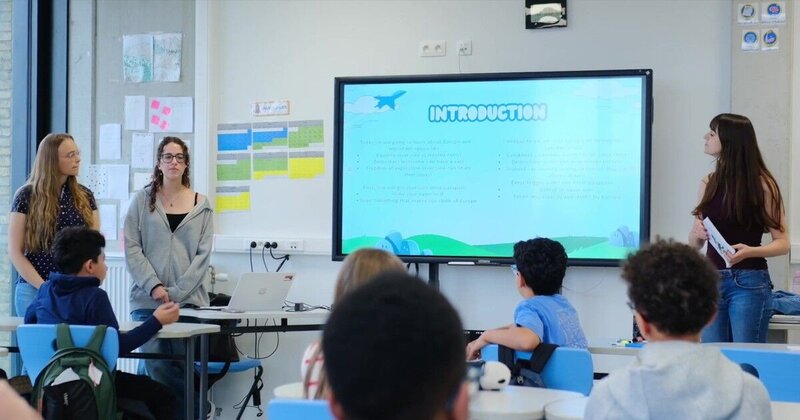
Would your school like to take part? From fall 2028 onward, we are looking for schools in Belgium that want to host an international student teacher and help test the framework and activities. Feel free to contact us.
#teachereducation #internationalpracticum #mentoring #ErasmusPlus #eTwinning #internationalization #multilingualism #Europe
Problem Statement
Teaching practice is the backbone of every teacher education program. Student teachers who complete a placement in a school in another European country get to know a different education system from the inside and grow in intercultural and professional competencies. Yet international teaching practice remains difficult to organize: teacher education is regulated nationally, and curricula and practicum traditions differ widely. Teacher education institutions across Europe often cite these barriers as a reason not to host international student teachers, and schools sometimes experience hosting an exchange student as demanding.
From the joint evaluations of the E3 semester, the partners identified four challenges that kept coming back:
- Language: exchange students often do not speak the language of the school and cannot teach in the pupils' first language.
- Prior education and teaching experience: teacher education and placement models vary widely between countries. Belgian students, for example, prepare a detailed multi-week teaching plan in advance, while Danish students develop their lessons together with the mentor teacher and the pupils.
- Curriculum and hidden curriculum: the curriculum determines how much freedom a student has, and many expectations remain unspoken.
- Cultural codes and school culture: every school has its own norms and ways of interacting that an international student still has to learn to read.
Schools asked for clearer guidance on how to receive and support exchange students, while teacher educators found it hard to give consistent answers given the wide variation between schools. In the existing literature on international practicum, we found no concrete proposals for working with these challenges and their potential.
Purpose of the project
With E3-Practicum, we aim to strengthen the quality of international teaching practice for student teachers across Europe. We want to:
- develop a transparent European competence framework that describes what student teachers learn during an international placement, beyond what a national placement offers;
- develop innovative methods to prepare, support and mentor exchange students, including through the European eTwinning platform;
- build an equal partnership between teacher education institutions and schools in educating future teachers.
In this way, we turn linguistic and cultural differences into learning opportunities for students, mentors and pupils, and lower the threshold for schools and teacher education institutions to host international student teachers.
Partners
E3-Practicum brings together four countries, four teacher education institutions and four primary schools. Each teacher education institution forms a national team with a partner school. This variety of education systems, practicum traditions and school contexts is exactly what makes the project strong.
Denmark
- Københavns Professionshøjskole (KP), Copenhagen: one of the largest university colleges in Denmark, with around 3,500 student teachers. Coordinator of the project.
- Vedbæk Skole, Vedbæk: primary school north of Copenhagen with expertise in co-teaching and practice-based learning.
Austria
- Pädagogische Hochschule Steiermark (PH Steiermark), Graz: university college of teacher education and teacher professional development. Leads the work package on the competence framework and activities.
- Volksschule BIPS Krones, Graz: bilingual (German-English) and inclusive primary school whose pupils speak up to thirty different first languages.
Spain
- Universitat Autònoma de Barcelona (UAB), Faculty of Educational Sciences: one of the major public universities in Spain. Leads the work package on collaboration between teacher education and schools.
- Escola Mercè Rodoreda, Barcelona: public preschool and primary school on the urban outskirts of Barcelona, recognized for educational innovation against inequality.
Belgium
- Odisee, teacher education: university of applied sciences in Flanders and Brussels, member of the KU Leuven Association. Leads the work package on dissemination and networking.
- GO! Basisschool Pacheco, Brussels: urban school in the center of Brussels where almost thirty languages are spoken, with expertise in urban education and diversity.
Associated partner
eTwinning Denmark: trains all partners in using the eTwinning platform and supports their collaboration
Method
Each teacher education institution forms a national team with its partner school. Exchange students take part as active co-creators: each partner school hosts at least two international student teachers every year, who contribute to activities at the school and at the teacher education institution. In Belgium, Odisee works with GO! Basisschool Pacheco. Odisee will welcome the partners to Brussels in May 2029 for the final meeting.
The project runs in four phases:
- Mapping (2026-2027): we compare curricula, frameworks and practicum procedures in the four countries and set up classroom interventions to identify good practices and competencies.
- Developing (2027-2028): based on these findings, we write a first version of the competence framework. Each national team develops at least three activities that support these competencies; the partner schools exchange and test them via eTwinning.
- Testing and refining (2028-2029): the framework, activities and guidelines are tried out in a wider group of twenty schools (five per country). At the same time, we develop models for preparing exchange students for their placement.
- Sharing and embedding (2028-2029): we publish the results as open educational resources and share them through European and national networks of teacher education institutions and schools.
Four transnational workshops in Copenhagen, Graz, Barcelona and Brussels, along with a shared workspace on eTwinning, connect all partners.
Expected output
- European competence framework: describes the knowledge, skills, attitudes and professional dispositions student teachers develop during a placement in another European country.
- Handbook for mentors and teacher educators: with guidelines, tested activities and models for preparing and supporting exchange students.
- Open educational resources: the framework and handbook will be freely available on eTwinning.
- Scientific article: a peer-reviewed publication on international practicum in European teacher education.
- Online multiplier event: an online event on eTwinning in May 2029 for schools and teacher education institutions across Europe.
Future practice results and materials: competence framework and handbook expected 2029
Project Team
- Jonatan De Geest, Promotor and teacher educator (Odisee University of Applied Sciences, Sint-Niklaas campus), [email protected]
- Jasmin Callaert, Co-promotor and teacher educator (Odisee University of Applied Sciences, Aalst campus), [email protected]

Want to know more?
Co-funded by the European Union. The views and opinions expressed are however those of the author(s) only and do not necessarily reflect those of the European Union. Neither the European Union nor the granting authority can be held responsible for them.