
Continuously Improving Your School Together
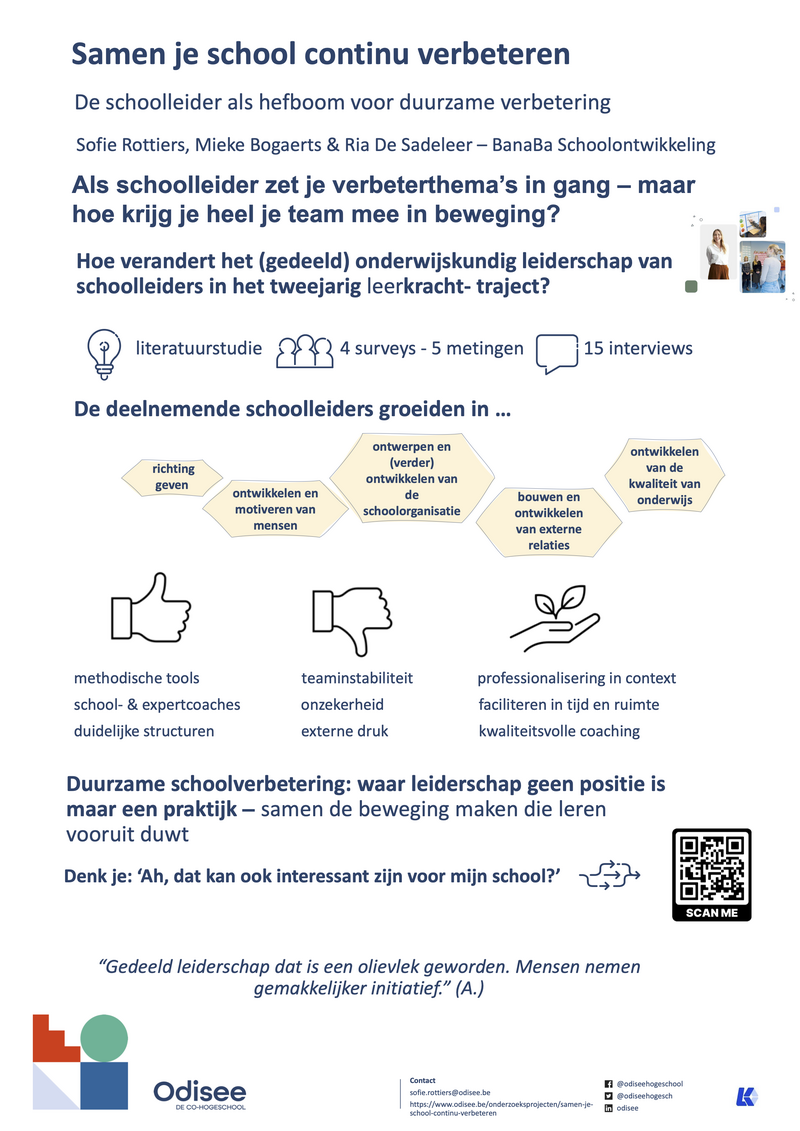
In the project ‘Continuously Improving Your School Together’, six school leaders and their school teams follow the change trajectory developed by Stichting LeerKRACHT. Throughout this process, we investigate to what extent this trajectory contributes to the professional growth of these school leaders. Within this growth, we take a closer look at educational leadership.
Educational policy is a recurring warning signal in school inspections and annual reports via the Onderwijsspiegel, with little observable progress over time. Through this research, we aim to determine whether participation in the change trajectory enables school leaders to adopt more effective educational leadership.
Research purpose and questions
Research objective
The research objective is twofold. We investigate whether completing a validated support programme, such as the one offered by Stichting LeerKRACHT (Jong et al., 2021), can be considered an external support initiative that, on the one hand, aims to professionalise school leaders from within and based on their own school context, and on the other hand, contributes to a positive evolution in (shared) educational leadership among the participating school leaders. We examine what this reveals about the professionalisation of school leaders with an impact on educational policy within our own Advanced Bachelor's programme in School Development.
Research questions
The theoretical framework led us to several compelling research questions, which were translated into one main question and three sub-questions.
Main question:
If the LeerKRACHT programme is followed, to what extent does the (shared) educational leadership of the school leader change in relation to the sustainable establishment of a learning culture?
Sub-questions:
- What characterises the professional growth in (shared educational) leadership of the school leader after completing the LeerKRACHT programme?
- To what extent did the initial level of the school, the school culture, and the (shared educational) leadership influence the further course of the change trajectory?
- Which elements of the support process promote or hinder professional growth in (shared educational) leadership?

Coaches getting started with the methodology Stichting LeerKRACHT
Within the framework of sustainable school development, the programme offered by Stichting LeerKRACHT aims to initiate a transformation towards a learning school culture in which teachers collaborate to improve education, and school leadership plays a supportive role (De Jong et al., 2021). To achieve this goal, Stichting LeerKRACHT introduces four tools or methodologies into the school. These instruments form the foundation of the LeerKRACHT programme (De Jong et al., 2021):
- Board sessions: short team-based work sessions in which teachers and school leaders set weekly goals and agree on improvement actions;
- Joint lesson design: teachers prepare lessons together, exchange experiences, and implement improvements in their teaching;
- Lesson observation and feedback: teachers observe each other in the classroom and discuss their observations together;
- Student voice: students provide feedback to teachers about the education they receive.
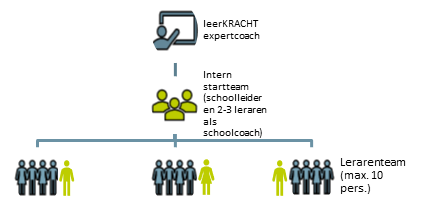
Figure 1. Overview of the support provided by Stichting LeerKRACHT to a school (De Jong et al., 2021)
The role of the school leader
The implementation of the LeerKRACHT programme appears to be strongly influenced by the role of the school leader. Not only does the programme itself assign a key role to the school leader, but in practice, the position taken by the school leader proves crucial to the success of the programme’s implementation and use within the school. The school leader affects the execution of board sessions, joint lesson design, lesson observation, and student voice by either encouraging or discouraging their application.
Moreover, the way in which the school leader collaborates with the external expert coach and the internal school coach also impacts the programme’s implementation. The school leader further influences three contextual factors essential to the programme’s success in schools: time allocation, the development of a learning school culture, and team composition and organisation. They provide teachers with time and space to work in the LeerKRACHT way, help build a learning culture (by creating sufficient room and an open atmosphere for shared responsibility among teachers, within clear frameworks), and generally decide which teams will implement LeerKRACHT and, in consultation with internal school coaches, determine the most effective team composition (De Jong et al., 2021).
These types of roles are also reflected in the work of Verbiest (2010), who identifies participative leadership roles for school leaders as follows:
- Culture builder: promoting a vision, norms, and views on learning, the need for professional and school development, and creating an affective climate;
- Teacher of teachers: guiding processes and dialogues; acting as a critical friend;
- Architect or structure builder: creating structures for shared leadership; providing time, space, and resources for collaboration and opportunities for team learning and mentoring (Krüger, 2010).
Leading change
Participating in the support programme by Stichting LeerKRACHT requires school leaders to guide the improvement culture and change process through clearly defined roles. To better support and coach school leaders in this, Stichting LeerKRACHT uses the change model (7S framework) developed by McKinsey. This model consists of four building blocks for successful change, based on scientific insights and practical experience. According to this model—developed by the consultancy firm McKinsey—change is achieved through the interplay of four elements (Figure 2):
- Conviction: The extent to which employees understand and believe in the change.
- Role model: The extent to which employees observe colleagues and leaders behaving in ways that support the change. Leading by example.
- Skills: The extent to which employees possess the right skills and feel confident to adopt new behaviours.
- Systems and processes: The extent to which structures, processes, and systems support the change.
Together, these four ingredients form the foundation for an internal shift in mindset and behaviour (Change Model – Stichting LeerKRACHT, 2023).
Figure 2. Change Model by Stichting LeerKRACHT – based on McKinsey consultancy (2023)

Enkele schoolleiders aan het woord:
‘Zelfs onze instappertjes in de onthaalklas weten perfect zélf waar ze verwacht worden en ze gaan zelfstandig met een opdracht aan de slag.’
‘Taalzwakke kinderen nemen het woord tijdens kringgesprekken.’
‘De leraar die sceptisch stond, is enthousiast over de aanpak bij instructie.’
‘Ook de impulscontrole van collega’s tijdens het teamoverleg verbeterde.’
‘Plots kwamen alle ouders naar het oudercontact.’
‘Leraren doen niet mee omdat het moet, maar omdat ze de meerwaarde zien.’
Bronnen
- De Jong, W. A., Lockhorst, D., Klein, T., Van Tartwijk, J., & Noordegraaf, M. (2021). Over de kracht van leerKRACHT. Eindrapportage van vierjarig onderzoek. Oberon.
- Krüger, M. L. (2010). De invloed van schoolleiderschap op het onderzoekend handelen van leraren in veranderingsprocessen: eindrapport Kenniskring Leren en Innoveren. (Kenniscentrumreeks; No. 6). Hogeschool van Amsterdam, Kenniscentrum Onderwijs en Opvoeding.
- Verandermodel - Stichting LeerKRACHT. (2023, 30 maart). Stichting leerkracht.
- Verbiest, E. (2010). Op weg naar Nieuw Onderwijskundig Leiderschap. School en begeleiding: Personeel en Organisatie, afl. 25.
Some school leaders speak out:
“Even our youngest pupils in the reception class know exactly where they’re expected to be and independently get started on a task.”
“Language-challenged children are speaking up during circle time.”
“The teacher who was initially sceptical is now enthusiastic about the instructional approach.”
“Even colleagues’ impulse control during team meetings has improved.”
“Suddenly, all parents showed up for the parent-teacher conference.”
“Teachers aren’t participating because they have to, but because they see the added value.”
Final report (Dutch)
Meet the researchers


Our partners
- Stichting LeerKRACHT
- Koning Boudewijnstichting