
Multifactor authentication (MFA) - FAQ
To secure your account, there is multifactor authentication (MFA). Frequently asked questions and corresponding answers about it can be found on this page.
General questions
MFA means multifactor authentication. It's an extra security step to better protect your account.
You first log in with your username and password. Then you always have to confirm your login via the authenticator app on your smartphone. Only when you confirm this will you gain access to your account.
Today, hackers are creative in finding and abusing accounts.
In the traditional way (with just a username and password), knowing your login information is enough for the hacker.
With the use of MFA comes another layer of security that can stop the hacker. Without approval of the login via the KU Leuven authenticator app, the hacker will not get into your account.
You must install the KU Leuven Authenticator app on your smartphone from the Google Play Store (for Android phones) or the App Store (for iPhones or iPads).

You should use the extra security step for your account on the central login screen you use each day to log in to the Student Platform, Toledo and KU Loket.
You can log in in two ways:
- Logging in with the KU Leuven Authenticator.
You click on the upper blue button.
Then you confirm your login with your PIN or with biometrics (e.g. fingerprint or facial recognition). -
Login with your Odisee email address and password.
First you enter your e-mail address and password. Then in the login screen you choose which device you want to confirm the login on with the Authenticator app. You'll get a push notification on that device. Tap "Next" to continue. The last step is to confirm with your PIN or biometrics.
If you click "No, this is not me," the login will be aborted.
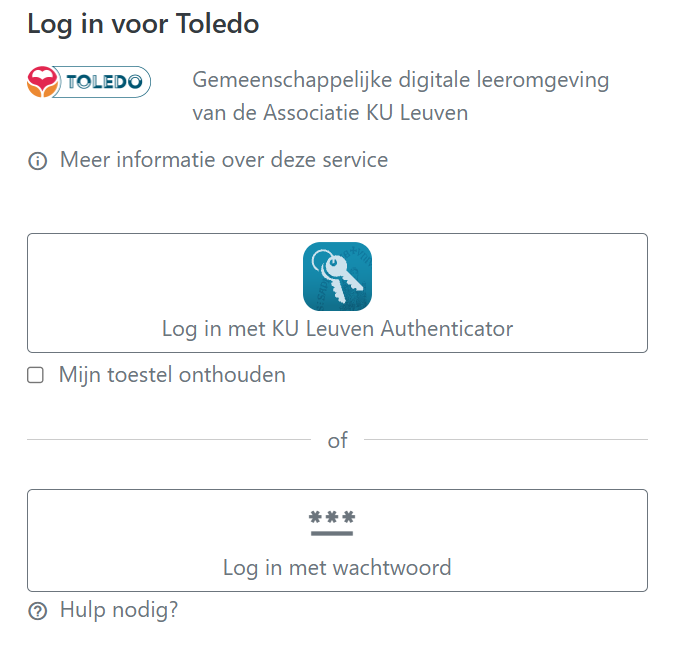
For the MFA on your account, you need the"KU Leuven Authenticator." You can download this from the Google Play Store and the Apple App store.
The activation of your account is followed by the activation of the MFA after setting your password.
You can find more information about the account activation process and a step-by-step plan at https://www.odisee.be/en/accounts.
If you have already activated your account (you have already chosen a password for it) but have not yet activated the MFA, please refer to the FAQ below "How do I register MFA for my account that is already activated?".
You'll find a clear manual on this page.
Your registration will remain valid for a maximum of 12 hours. Do you close your browser completely? Then you are automatically logged out. When you change wifi or network, you also have to log in again.
This is why you need the app'KU Leuven Authenticator' on your smartphone every day.
On this page we give some more tips for efficient use of the KU Leuven Authenticator.
There is no charge for using the KU Leuven Authenticator app for MFA.
Smartphone related questions/problems
You can remove your lost or stolen device as an MFA device and register a new device yourself , using your reset code or through itsme. On this page we explain how to do this.
The ICT Service Desk can temporarily disable the MFA obligation (maximum 7 days) until you have a new device. To do so, stop by the ICT Service Desk on your campus.
You will need your smartphone to sign in. It is important to have it charged with you.
If you need to login for an exam or evaluation very urgently and have forgotten your smartphone, please contact the ICT service desk on your campus. They can disable the mandatory MFA for a short time.
You will need your smartphone to sign in. It is important to have it charged.
First look for a charger at a fellow student or colleague, ask if you can use it and charge your smartphone.
If you have to register for an exam or evaluation as a matter of urgency and you cannot borrow a charger from anyone, contact the ICT service desk on your campus. They can switch off the mandatory MFA for a short time.
When you have a new smartphone, you must register it as a new device for Multifactor Authentication (MFA). MFA is device-specific through the use of the smartphone app.
You still need your old smartphone to register your new device.
-
Download the KU Leuven Authenticator app on your new smartphone
-
Log in with the KU Leuven Authenticator on your old smartphone
-
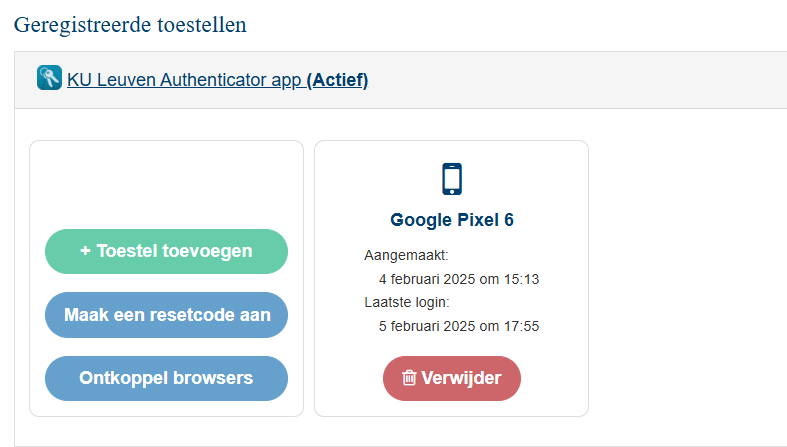
Click on the 'Manage authenticator' tile.
-
A new tab will open, login again and confirm the login on your old device via the authenticator app.
-
You will be taken to an overview page where you can see which devices are registered for your account. (You can manage them there).
-
Click 'Add device' to register your new device.
-
You follow the same steps as the activation of MFA on your old smartphone. These steps can be found on this page.
Students without smartphones are advised to contact their campus ICT Service Desk.
Odisee staff has the option to request a hardware token at https://servicedesk.odisee.be with the motivation why you cannot or do not want to use the app. However, we strongly discourage this.
This token is a container the size of a USB stick that generates a code that you can use as a second factor. It is necessary to have this with you at all times. It lowers the ease of use since you need both username and password and the token code every time you log in. When using the app on your smartphone, you can log in passwordless by using 'remember device'. See the tips you here can be found here
Questions/Problems with Authenticator app
Are you experiencing technical difficulties using the KU Leuven authenticator app? Then please contact the Odisee's ICT service desk on your campus.
The KU Leuven Authenticator requires a working internet connection. Therefore, if your device is temporarily unable to access the Internet, you will not be able to log in using KU Leuven Authenticator. Are you experiencing technical problems using the KU Leuven Authenticator app?
Yes, you can. You log on to https://myaccount.odisee.be/ where you can manage your registered devices and add an additional device to confirm your registration via the KU Leuven authenticator app.
But please note that the KU Leuven authenticator should only be registered on a personal, non-shared device.
If you have a reset code , you can use the reset code to delete all your registrations. On this page we explain how to do this.
If you do not have a reset code but do have a card reader + electronic identity card or itsme, you can also use it to delete all your registrations. You can find more instructions on this on this page. Please note, this only works if you have a Belgian national number known to us.
If none of the above options works, contact the Odisee ICT service desk at your campus, they can delete your registration and you can register again.
If your device is correctly added to your account then logging in will be as follows:
- You surf in your browser to www.odisee.be/dashboard and get the login screen of the association.
- You click on the"KU Leuven Authenticator" button and a QR code appears on your screen.
- You open your KU Leuven Authenticator and click on "Scan QR". You scan the QR code on your screen.
- You confirm in the Authenticator app with your pin code or via biometrics (fingerprint, facial recognition)
- You are then logged into your browser.
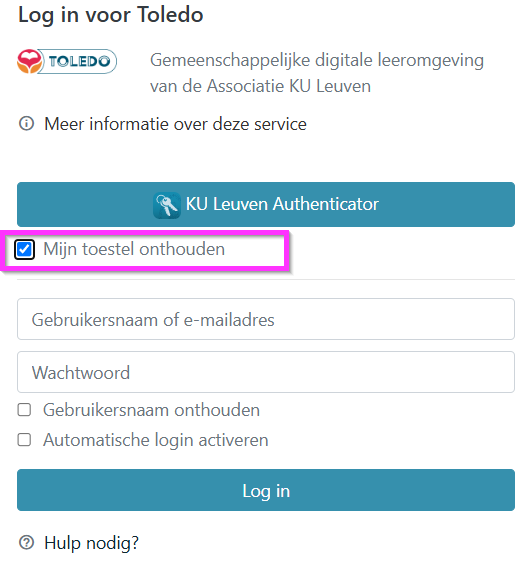
TIP! You can also make it even easier by checking the"Remember my device" option on the KU Leuven Association login screen. The next time you need to log in, all you have to do is click the "KU Leuven Authenticator" button and follow the instructions on your smartphone. You will then no longer need to type in your account name and password.
At this page we give some more tips for efficient use of the KU Leuven Authenticator.
If you have another question about the use of the KU Leuven Authenticator, you can take a look at the FAQ page of KU Leuven itself.
Keep in mind that not all KU Leuven features necessarily apply to Odisee. Odisee does not work with tokens for students.
As an Odisee student or employee, you can contact the Service Desk of Odisee, and not the one at KU Leuven.